

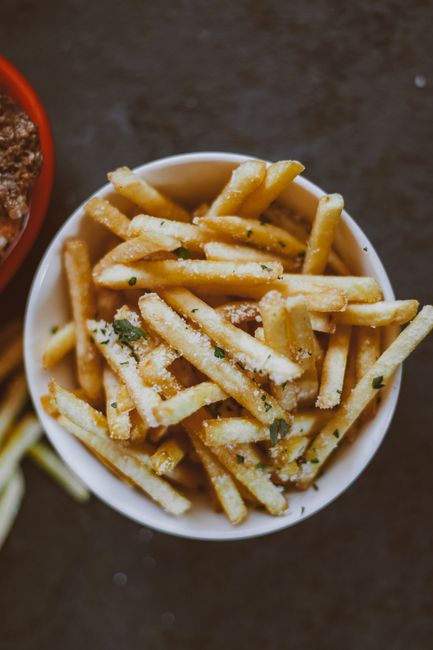
French fries look simple, but consistently crisp results depend on several details working together: the potato’s starch level, the thickness of each piece, the amount of surface moisture, and the cooking temperature. The most reliable approach is to cut evenly, rinse away excess starch, dry thoroughly, and cook the potatoes twice.
What type of potato makes the crispiest fries?
High-starch potatoes usually produce the best balance of a crunchy exterior and fluffy center. Russet potatoes are a dependable choice because they contain less moisture than waxier varieties and develop a firm crust during frying.
Gold-fleshed and red-skinned potatoes can also be used, but their texture is usually denser and more tender rather than especially crisp. Small new potatoes and other waxy varieties tend to hold their shape well, yet they generally contain more moisture and less starch for forming a brittle outer layer.
Choose potatoes that are firm, dry, and free from soft spots. Avoid potatoes with a strong green color beneath the skin. A small amount of green can be trimmed away, but extensive green discoloration is a reason to discard the potato.
Why should cut potatoes be rinsed or soaked?
Rinsing removes loose starch from the surface. Too much surface starch can cause fries to stick together and may produce a thick, uneven coating instead of a delicate crust.
After cutting, place the potatoes in a bowl of cold water and gently stir them. Drain and repeat until the water looks noticeably clearer. A longer soak of 30 minutes to several hours can help, especially when the potatoes feel particularly starchy.
Soaking is not a substitute for drying. Water left on the potatoes creates steam, interferes with browning, and can cause hot oil to splatter. Spread the drained potatoes on clean towels and pat them thoroughly. For especially crisp results, allow them to air-dry for several minutes after towel-drying.
How thick should French fries be cut?
A consistent thickness matters more than choosing one exact size. Fries cut about one-quarter inch thick usually cook quickly and become quite crisp. Fries closer to three-eighths inch have a softer, more substantial center while still developing a crunchy exterior.
The main problem is uneven cutting. Thin pieces may become dark before thick pieces are cooked through. A sharp knife and a flat cutting surface make the task safer and help produce more uniform pieces.
Trim the potato into a flat-sided shape before cutting it into planks. Then cut those planks into sticks. The trimmed pieces can be saved for roasted potatoes, soup, or another preparation rather than discarded.
Why does frying twice work better?
The first cooking stage gently cooks the inside without heavily browning the outside. The second stage raises the heat and quickly creates the crisp crust.
For a traditional oil-fried method:
- Heat oil to approximately 325 degrees Fahrenheit.
- Fry small batches for several minutes, until the potatoes are tender but pale.
- Remove them to a rack or paper-lined tray and let them rest.
- Increase the oil temperature to approximately 375 degrees Fahrenheit.
- Fry again until golden and crisp.
Do not crowd the pot. Adding too many potatoes at once causes the oil temperature to drop, leaving the fries greasy and soft. Small batches also allow the pieces to move freely and brown more evenly.
A heavy pot with plenty of headspace is safer than a shallow pan. Use a thermometer if possible, since oil temperature can be difficult to judge by appearance alone. Keep water away from hot oil, and never leave heating oil unattended.
Can crispy fries be made in an oven or air fryer?
Yes. Oven and air-fryer methods can produce crisp fries with less oil, although the texture may differ slightly from deep-fried potatoes.
For oven fries, dry the potatoes very well and toss them with a light coating of oil. Arrange them in a single layer on a sturdy baking sheet, leaving space between the pieces. A crowded pan traps steam and encourages soft fries. Turn the potatoes partway through cooking so both sides brown.
An air fryer works best with small batches. The hot circulating air needs room to move around every piece. Shake the basket or turn the fries during cooking, and avoid adding so much oil that the surface becomes wet.
In humid conditions, including damp summer days in Middletown, DE, potatoes may take longer to crisp because moisture remains in the air and on the food. Extra drying and more space between pieces can help.
When should fries be salted?
Salt fries immediately after cooking, while their surface is still hot and slightly oily. This helps the seasoning adhere evenly.
Salting before frying can draw moisture to the surface and may contribute to uneven browning. If using additional seasonings, add them after cooking as well. Fine salt distributes more evenly than large crystals, so only a small amount may be needed.
For a more evenly seasoned batch, toss the hot fries gently in a wide bowl rather than sprinkling heavily in one spot.
What causes fries to turn soggy?
Several common mistakes lead to soft fries:
- The potatoes were not dried thoroughly.
- The oil or cooking surface was not hot enough.
- Too many pieces were cooked at once.
- The fries were stored in a sealed container while still hot.
- The finished fries were placed in a deep pile instead of spread out.
- The potatoes were cut too thick for the cooking time.
- Steam collected beneath the fries on a flat plate.
To preserve crispness, place cooked fries on a wire rack or a tray lined lightly with paper. Avoid covering them tightly. If holding them for a short period, keep them spread out in a warm oven rather than sealing them in a container.
Is soaking in salt water or vinegar necessary?
Neither is required, but both can be useful in specific situations. Salt water seasons the potatoes lightly and may help maintain a firmer texture. A small amount of vinegar in the soaking water can help the potatoes hold together, which is useful for very thin fries or for cooks who prefer a firmer bite.
These additions cannot correct poor drying, an overcrowded pan, or an incorrect cooking temperature. The basic steps remain more influential: even cuts, clean surfaces, thorough drying, and enough room during cooking.
How can leftover fries be reheated?
The oven, toaster oven, or air fryer is generally better than a microwave. Microwaves heat the moisture inside the fries and often leave the exterior limp.
Spread leftover fries in a single layer and reheat them at a moderately high temperature until hot and crisp. Avoid piling them up. If the fries are heavily salted or have been stored with a moist sauce, they may not return to their original texture.
For the most consistent results, cook only the amount likely to be eaten soon. Freshly finished fries have a texture that reheating can improve but rarely duplicate.
A dependable process for crisp results
The most repeatable method is straightforward: use a high-starch potato, cut it evenly, rinse or soak it, dry it carefully, cook it gently first, and finish it at higher heat. Whether using a pot of oil, an oven, or an air fryer, spacing and moisture control matter as much as the equipment.
For households preparing fries in a busy kitchen, the practical advantage is that the potatoes can be cut and soaked ahead of time. Drain and dry them before cooking, then finish in small batches so each serving stays hot and crisp.